Every first Monday of September, America pauses to honor the people who build it. We celebrate the nurse finishing a night shift, the teacher setting up a classroom before the first bell, the civil engineer double-checking a bridge design, the accountant who keeps a small business solvent. These are also the stories of thousands of Dreamer college graduates applying their education and ambition to give back to their communities and the country they call home.
This year, I want to widen the frame. Because alongside the workers we celebrate, there is a group of Dreamers who have done everything we ask of trained professionals but remain stuck in a talent pipeline due to an authorization gap.
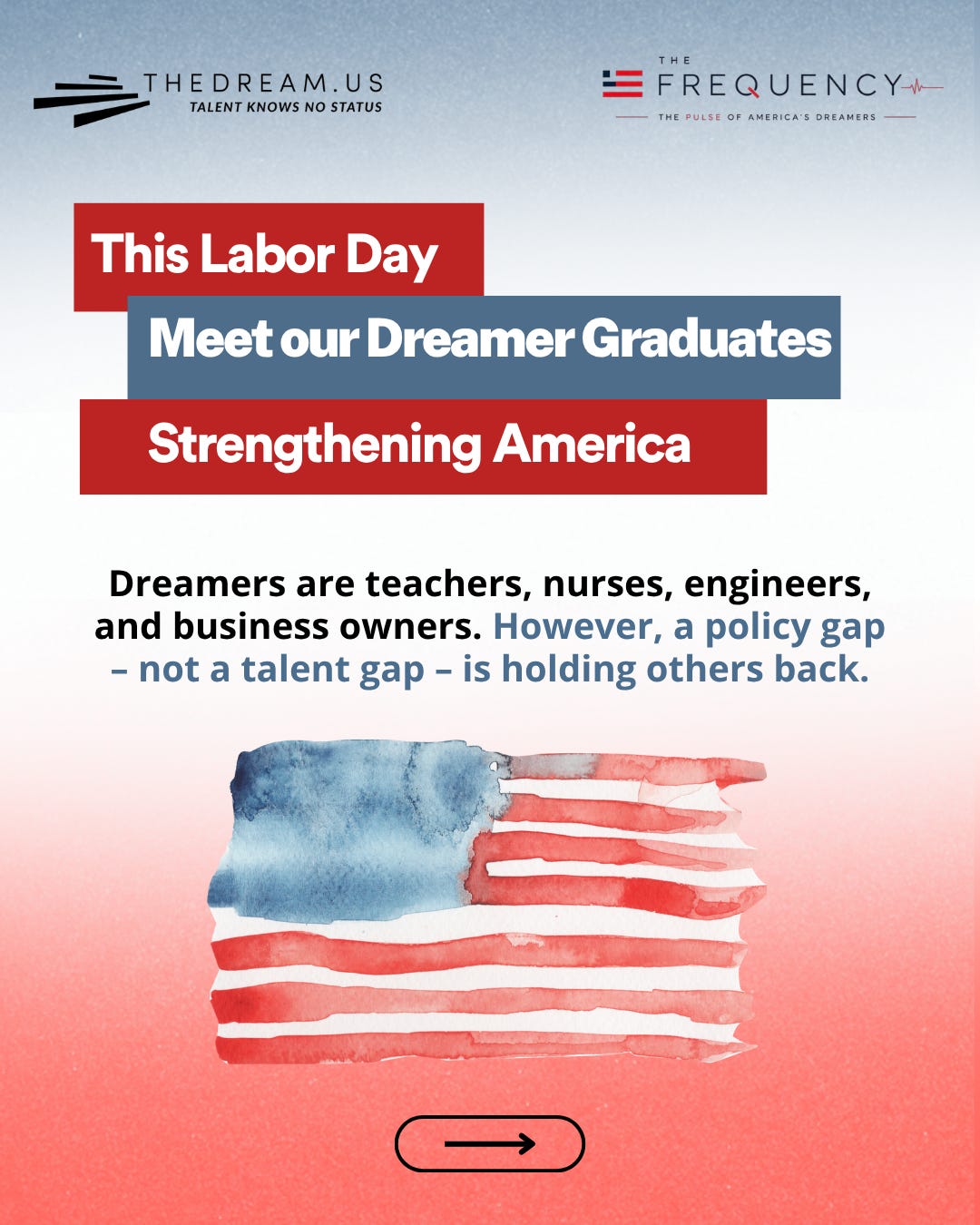
Educated, Trained, Only to Be Sidelined
TheDream.US released its 2026 Alumni Survey Report – The Authorization Gap – this summer, and the findings have stayed with me all season. The survey reached more than 2,500 Dreamer college graduates, drawn from a community of over 5,000 alumni spread across 44 states and Washington, D.C. Their median age is 26. Most arrived in this country at about age four. They have been here more than two decades, growing up deeply embedded in America’s public-school systems and coming of age on college and university campuses across the country. They are first-generation college students, that have beaten the steepest of odds to earn their bachelor’s degrees and have gone into exactly the fields our country needs the most: healthcare, education, business, science, and technology.
One in five of the graduates we heard from are Dreamers without DACA or TPS – the largest such number we’ve encountered in our Alumni Surveys. This group gives us something rare in policy debates: a clean comparison. Same scholarship, same universities, same degrees, same drive. The only variable is whether the federal government has provided them the opportunity to gain a piece of paper allowing them to get hired and be provided deportation protections.
The difference that paper makes is stark. Among graduates with DACA or TPS, 84 percent are earning a full-time income. Among their peers without DACA or TPS, that figure drops to 43 percent. Nearly a third of this group are actively searching for income, compared with just 7 percent of their “authorized” peers. And when we asked whether their current work reflects what they actually trained for, 82 percent of “authorized” graduates said yes. For Dreamers without DACA or TPS, it was 45 percent.
Read that again with Labor Day in mind. We are honoring work while, in 43 states and the District of Columbia, we are legally barring one in five of these graduates, who arrived here at age four, from obtaining the professional licenses that would let them practice as the nurses, teachers, lawyers, and engineers they spent years becoming.
What the Rest of Us Lose
It is tempting to see this as a story about Dreamers alone. It is not. It is a story about a country and all of us, Americans, leaving its own investment on the table.
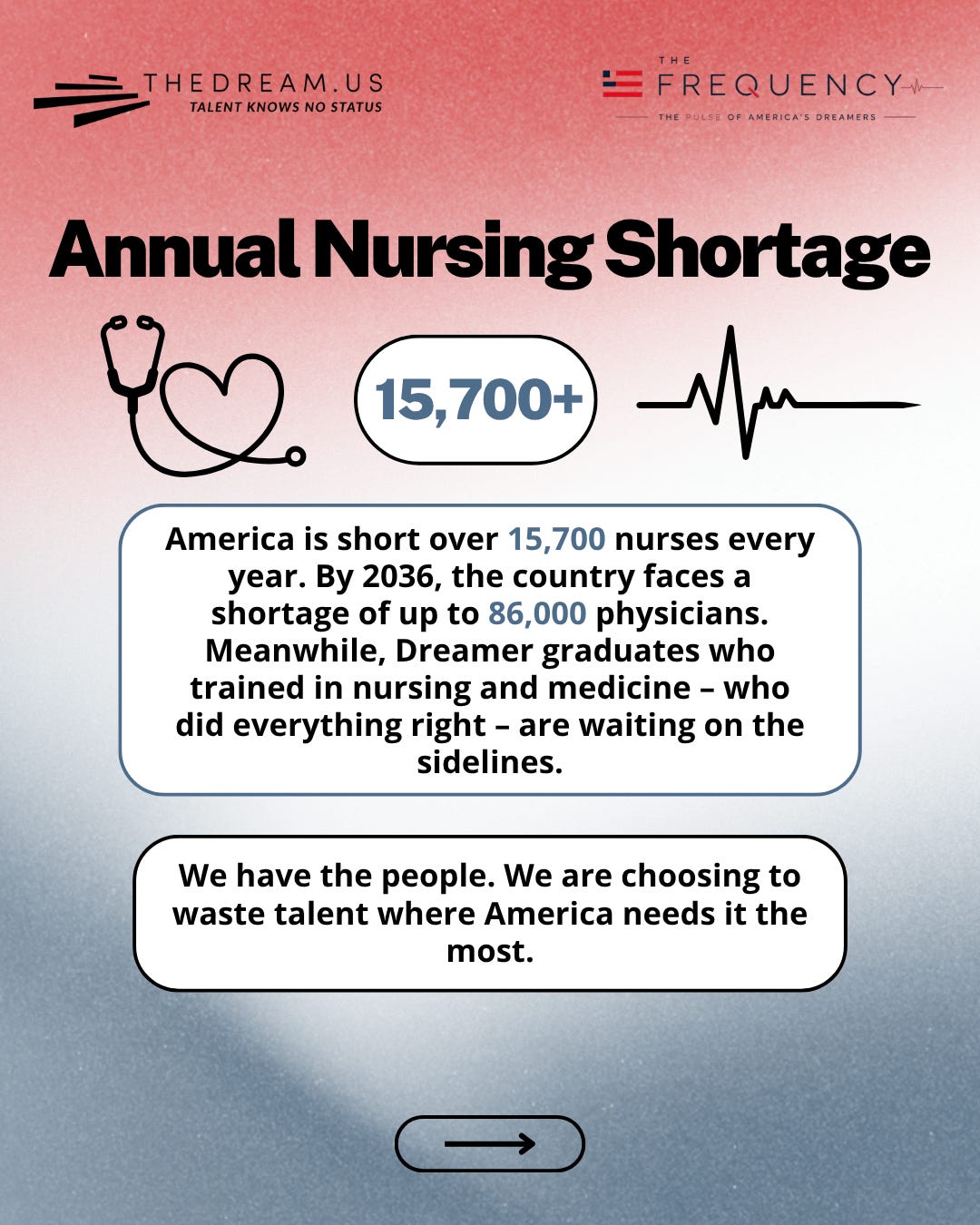
The United States is short roughly 15,700 nurses a year. We have more than 45,000 teaching positions we cannot fill. We are projected to be short as many as 86,000 physicians by 2036. Meanwhile, we have trained thousands of people for precisely those roles and then told them to sit down. Every unfilled hospital shift and every classroom staffed by a long-term substitute is, in part, a policy choice.
The economics are just as lopsided. DACA recipients alone pay an estimated $9 billion in federal, state, and local taxes each year, including more than $2 billion into Social Security and Medicare, programs they are not guaranteed to ever draw from without permanent legislative solutions. Extending that same opportunity to Dreamers without DACA would not be charity. It would be collecting a return on an education America already helped fund.
And the cost of inaction does not stop at the individual. Three in five of these graduates have family members who depend on their income. One in four is married. One in seven is a parent. When we sideline a Dreamer, we destabilize an American household, often one that includes U.S.-citizen children and parents who can no longer safely go to work themselves. And we isolate individuals who are deeply integrated into their communities and this nation.
Twelve years in the Waiting Room
Being shut out of the workforce is not abstract to me.
I spent the first twelve years of my life in America on a student visa, struggling to find a path forward. Twelve years of being told, in effect, that I was welcome to learn but not to fully belong. I could pay to study, I could earn degrees, I could volunteer, but my ability to work was fenced in by rules that had nothing to do with my ability, my effort, or my ambition. For more than a decade, I felt that sense of shame, like I was being left behind, like I was powerless in letting life slip through my fingers. I cannot fully describe how much I yearned for something as ordinary as a work permit, the simple permission to put everything I had learned to use.
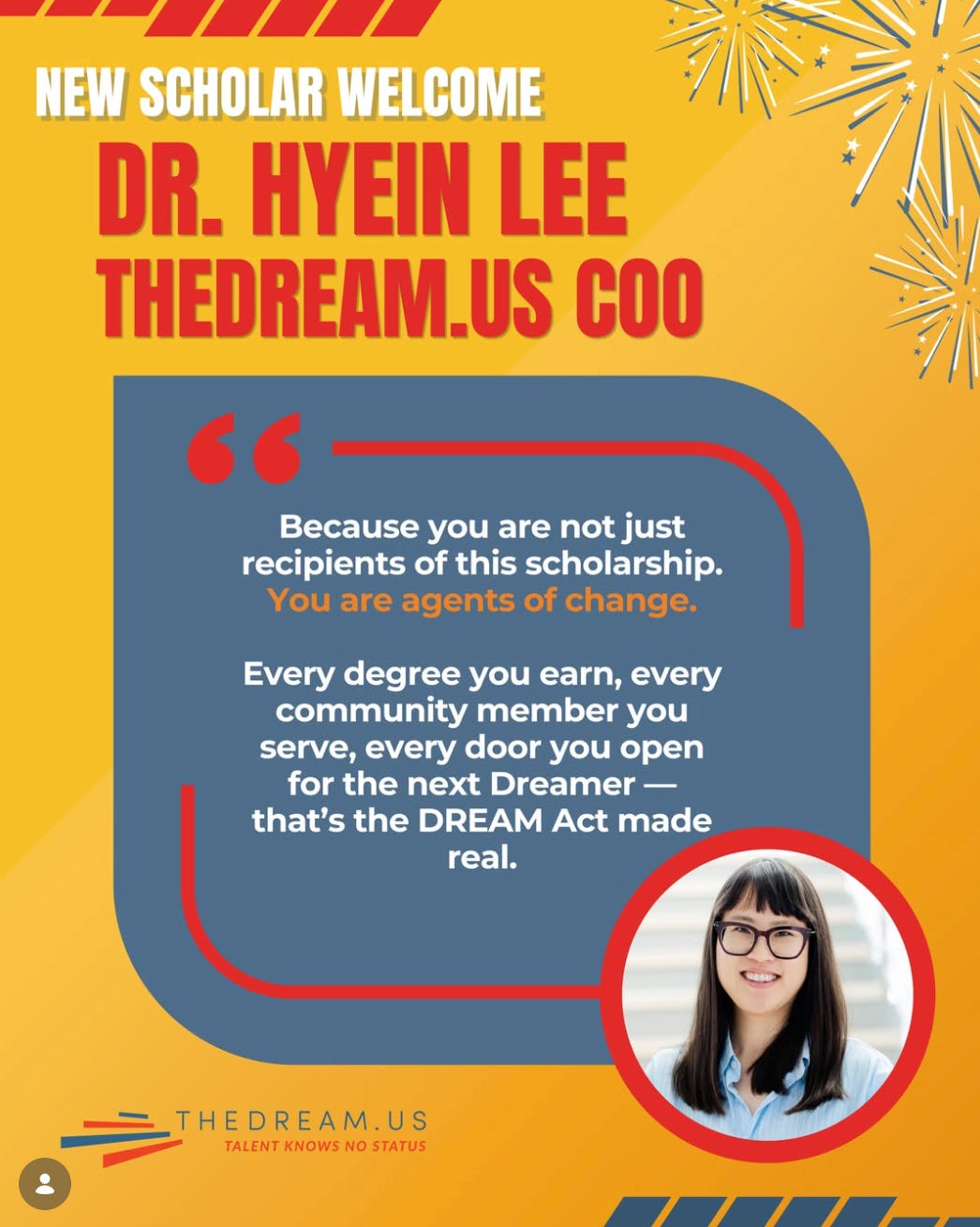
When that door finally opened, and I was given the chance to join TheDream.US as an employee, it changed the trajectory of my life. Not because a job is the whole of a person, but because work is how most of us translate what we know into what we contribute. Overnight, my education stopped being a private accomplishment and became something I could use to benefit others. Today I get to advocate for Dreamers on a national scale, which means the years I spent waiting are no longer a story about what I lost. They are the reason I understand, in my bones, what our Scholars and graduates are waiting for.
That is the part I most want people to hear. When you unlock an immigrant’s ability to work, you do not just improve one life. You create someone who spends the rest of their career paying it forward.
Opportunity is not a zero-sum game
The mistaken assumption underneath so much immigration policy is that opportunity is a pie: a slice for them means a smaller slice for the rest of us. Our data says the opposite. Dreamers with work authorization are not taking jobs from Americans. They are filling the ICU shifts, the middle-school science classrooms, and the small-business ledgers that would otherwise sit empty. Imagine the potential of expanding economic opportunity to all Dreamers, qualified and eager to practice their professions.
Providing opportunity to immigrants is not a favor we do for immigrants. It is an investment we make in ourselves, in our hospitals, our schools, our tax base, and the neighborhoods where these graduates already live and raise their families.
So this Labor Day, celebrate the workers. Thank the nurse, the teacher, the engineer, the accountant. But also ask why we are keeping thousands of people who trained for those exact jobs on the sidelines because of a status they had no say in.
Congress can close this gap. We already have the talent. We already made the investment. All that is missing is the permission to work. Permanent protections for Dreamers, with or without DACA, would turn a decade-long waiting room into a workforce.